Historical
Background
|
After
the partition of India, the Constitution of India was
framed. However, before the partition, there was the Government of India Act, 1915. By virtue of the
powers conferred by Section 113 of the Government of
India Act,1915, the Crown by Letters Patent dated March 20, 1919 had
established at Lahore, the High Court of judicature for the
provinces of Punjab and Delhi to be called 'the High Court
of judicature at Lahore'. The High Court of judicature at
Lahore was a court of record. | |
Lahore High Court |
On the establishment of
the Lahore High Court, the Chief Court of Punjab, which was
functioning for the last 53 years, was abolished. The High
Court at Lahore by virtue of Letters Patent and Section 106
and 113 of the Government of India Act, 1915 was vested with
all the appellate and superintending powers, authority and
jurisdiction of the Chief Court. The Lahore High Court by
its Letters Patent was also vested with original
jurisdiction in certain special matters as were possessed by
the Chief Court. These special matters included disciplinary
action against Advocates (Clause 8); Guardianship (Clause
12); testamentary and intestate (Clause 24)and matrimonial
matters (Clause 22). The High Court had no ordinary original
civil jurisdiction. However, it had ordinary original
criminal jurisdiction to a limited extent. The original
criminal jurisdiction of the Lahore High court was
co-extensive with that of the chief court of Punjab which
had no original criminal jurisdiction to try any person,
except European British subjects. As per Clause 9 of the
Letters Patent, it was empowered to remove, try and
determine any civil case from courts subordinate to it. In
exercise of its appellate jurisdiction, the Lahore High
Court was authorized to hear appeals from the decisions of
all the criminal and other courts of the provinces of
Punjab, Delhi and all other Courts subject to its
superintendence. It could hear appeals in Benches of two or
more Judges of its own Court sitting on the civil side.
 |
It
was also declared to be Court of reference and revision from
the criminal courts subject to its appellate
jurisdiction. It had the powerto transfer any
criminal case or appeal from any court to any other
court of equal or superior jurisdiction. It had no
power to issue writs except to the extent as it was
empowered to issue orders in the nature of habeas
corpus
under Section 491 of the Code of Criminal
Procedure along with other High Courts.
|
Post
Independence scenario
After
independence of India, the old province of Punjab was
divided into West Punjab (Pakistan) and East Punjab (India).
The High Court at Lahore being in Pakistan, ceased to have
jurisdiction over Delhi and East Punjab. The question of
location of the new High Court for these provinces arose.
Shimla was selected as the seat of the new High Court.
|
The East Punjab High Court of judicature was established at
Shimla on August 15, 1947 by the Governor General's High
Court (Punjab) Order 1947 issued under Section 9 of the
Indian Independence Act, 1947. In exercise of the powers
conferred by Section 229 (1) of the Government of India Act,
1935, the High Court of East Punjab was also made a court of
record and as provided by Clause 5 of the said order, it had
in respect of the provinces of Punjab and Delhi, all such
original, appellate and other jurisdictions as under the law
in force immediately before the August 15, 1947, was
exercisable in respect of those territories by the High
Court at Lahore. The East Punjab High Court was the
successor and continuation of the High Court at Lahore. The
decisions of Lahore High Court were binding on the Punjab
High Court on the principle of stare decisis. The
Constitution of India came into force on January 26, 1950.
The State of East Punjab came to be known as the Punjab now.
Accordingly, the name of the High Court was also changed. As
per Article 214(2) of the Constitution of India, the High
Court was to be continued along with other High Courts. The
Constitution of India also conferred on the Punjab High
Court, along with all other High Courts, the power to issue
directions, orders including writs in the nature of habeas
corpus, mandamus, prohibition, quo-warranto and certiorari in
the enforcement of fundamental rights or for any other
purpose. The East Punjab High Court did not have the power
to issue writs. However, the seat of the High Court
continued to remain at Shimla.
High Court
shifted
On
account of its inclement weather in winter, it was very
inconvenient for the litigants to go to Shimla. Accordingly,
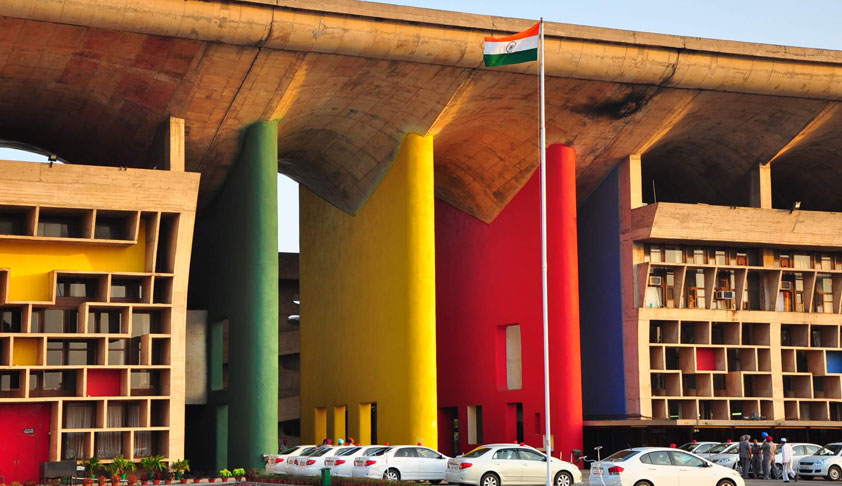
the seat of the High Court was shifted to Chandigarh.
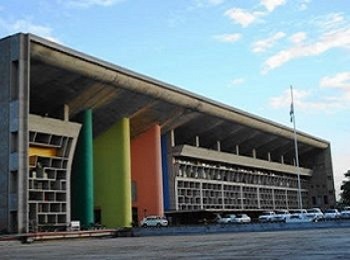
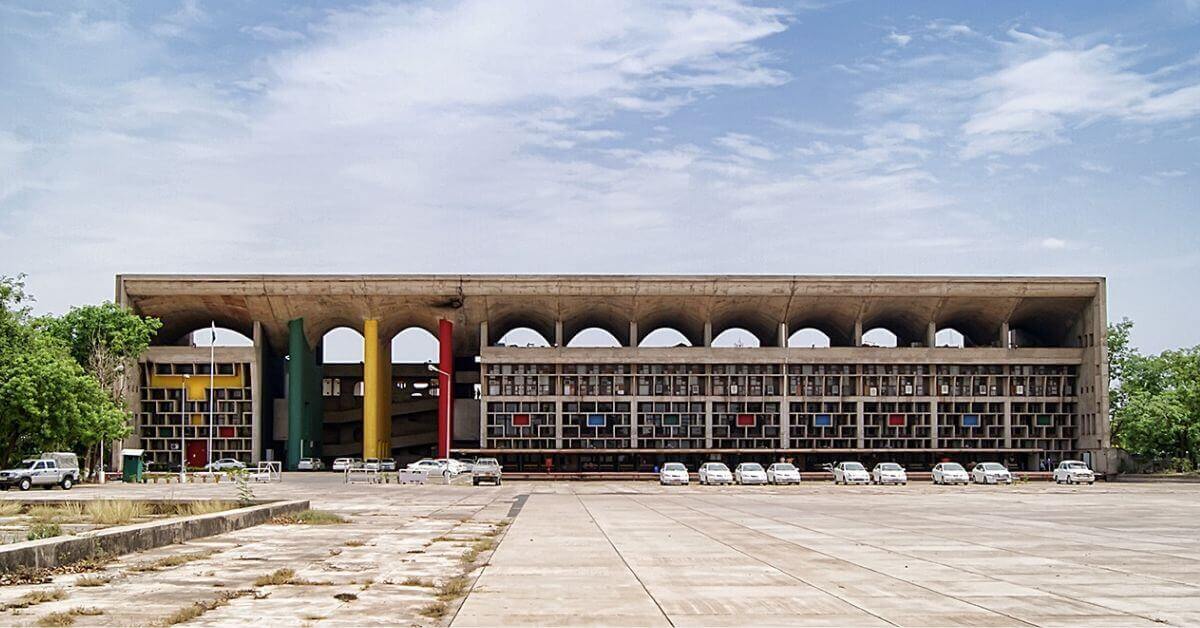
The
Court started functioning at Chandigarh from its
present building with effect from January 17, 1955

However,
it was formally declared open by the first Prime Minister of
India, Pandit Jawahar Lal Nehru, on March 19, 1955. The
plan of the building of the High Court was designed by the
world famous French Architect, 'Le Corbusier' under the
exuberant guidance of Hon'ble the then Chief Justice, Mr.
Justice A.N. Bhandari.
<
Pepsu High Court merged
There
existed the Patiala and East Punjab State Union (Pepsu)
along the State of Punjab, which had also its own High Court
known as 'Pepsu High Court'. However by the States Re-organisation
Act, 1956 the State of Pepsu was merged in the State of
Punjab. The Judges of the High Court of Pepsu became Judges
of the Punjab High Court. The strength of the Punjab High
Court, which had originally 8 Judges rose to 13. The Punjab
High Court also assumed jurisdiction over the territories
which were earlier under the Pepsu High Court.
Delhi High Court created
There
existed a Bench of the Punjab High Court at Delhi since
1952, which was installed by the Governor General under the
power conferred on him by Clause 33 of the Lahore Letters
Patent. However, a separate High Court was constituted for
the Union Territory of Delhi under the Delhi High Court Act,
1966. Three Judges of the Punjab High Court were transferred
to Delhi High Court. The High Court of Punjab also ceased to
exercise jurisdiction in respect of Union Territory of Delhi
from October 31, 1966. All the cases arising within the
jurisdiction of Delhi High Court were transferred from the
Punjab High Court to the High Court of Delhi.
High Court of
Punjab and Haryana created
A
new chapter opened in the history of the High Court in the
year 1966. The States Re-organisation Act, 1966, brought
another State named Haryana and the Union Territory of
Chandigarh into existence from November 1st, 1966. From the
date of enforcement of the said Re-organisation Act, the
High Court of Punjab was renamed as 'the High Court of
Punjab and Haryana'. The Judges of the High Court of Punjab
became Judges of the common High Court with all the powers
and jurisdiction of the High Court of Punjab. However, the
principal seat of the High Court remained at Chandigarh.
The
High Court of Punjab and Haryana is working since November
1, 1966 in its present form. It is one of the most beautiful
High Courts in India with 40 spacious and luxuriously
furnished courtrooms; 3 Bar rooms; a well-equipped Judges'
library, a dispensary and a very good canteen. Its location
in the lap of Himalayas beyond the limits of the city,
beside Assembly Hall and Sukhna Lake add to its beauty. The
sanctioned strength of the High Court is 38 permanent and 30
additional Judges.
CJI
presenting souvenir to the President on the Golden
Jubilee celebrations
The
High Court completed 50 years of its existence on
March 19, 2005.
Accordingly, the year 2005-2006 was
celebrated as Golden Jubilee Year of the High Court. Many functions were held to
commemorate the event.
However, the main function was held on
December 10, 2005 in the premises of the High Court. His Excellency, the President of India, Mr A P J Abdul Kalam
was the chief guest of the function.
The Chief Justice of India, Hon'ble Mr
Justice Y K Sabharwal; other Supreme Court Judges;
Hon'ble Judges of Delhi High Court, Himachal Pradesh
High Court, Lahore High Court and former judges also
attended the function.
Hon'ble Union Law Minister, Mr H R Bhardwaj;
His Excellency, Mr S F Rodrigues, Governor of
Punjab; His Excellency, Mr A R Kidwai, Governor of
Haryana; Chief Minister of Haryana, Mr Bhupinder
Singh Hooda; Deputy Chief Minister of Punjab, Mrs
Rajinder Kaur Bhattal were other dignitaries, who
participated in the function.>
A souvenir was also released on the occasion.
The
State
Governments of Punjab and Haryana also hosted
special dinners in honour of guests. On
that very day,
Hon'ble Chief Justice of India also laid the
foundation stone of the State Judicial Academy, at
Sector 43, Chandigarh.
The Chief Justice of the High Court formally
closed the Golden Jubilee celebrations on March 18,
2006. An
exhibition was opened on that day.
It was inaugurated by Mrs. Padma Bhandari,
wife of Hon'ble Mr. Justice A N Bhandari, who was the
Chief Justice of the Punjab High Court in the year
1955, when the High Court had started functioning
from the present building. Conceived
by a committee comprising Hon'ble Mr. Justice M M Kumar,
Hon'ble Mr. Justice Hemant Gupta; Hon'ble Mr. Justice
S S Saron; Hon'ble Mr. Justice Rajive Bhalla, Hon'ble
Mr. Justice S N Aggarwal, the exhibition drew
crowds and was a great success. The exhibition
remains open on all days except Sunday. The
entry to the exhibition is free. |